

Cannabis Terms, Acronyms, and Dispensary Abbreviations: The Complete Cannabis Glossary
Know your cannabis terms, know your product. It’s that simple. Dispensary menus and product labels are packed with cannabis terms that give you important information on what you buy and how it affects you. Clear definitions make it easier to understand potency, product formats, and the abbreviations that appear on every package. This glossary breaks down the cannabis terms buyers encounter every day, from plant biology and effects to concentrates, cartridges, and lab report acronyms. Bookmark this guide and return any time a label or menu leaves you guessing.
Plant Biology and Anatomy
Everything on a dispensary menu originates in the cannabis plant. These cannabis terms describe what the plant is made of, how it produces its effects, and what buyers are consuming at a chemical level. Understanding plant biology makes every label and product description easier to read.
Cannabis
Cannabis is a genus of flowering plants (Cannabis sativa, Cannabis indica, and Cannabis ruderalis) and the root of all cannabis terms on every Pennsylvania dispensary menu. Hundreds of compounds called cannabinoids make up its chemical profile. Pennsylvania consumers can vaporize or apply cannabis topically. Inhaling delivers effects within minutes. Eating cannabis-infused troches delays onset by 30 to 90 minutes and extends duration significantly.
Cannabinoid
Cannabinoids are the active compounds in cannabis that bind to receptors in the human endocannabinoid system and one of the most important cannabis terms for any buyer to understand. The plant contains over 100 distinct cannabinoids producing physical and mental effects ranging from pain relief to euphoria. THC and CBD are the two most researched and the two most commonly listed on Pennsylvania dispensary menus.
Endocannabinoid System (ECS)
The endocannabinoid system is a network of receptors, enzymes, and naturally produced compounds distributed throughout the human body and brain. Understanding the ECS helps to understand other cannabis terms related to effects and dosing. The ECS regulates pain, mood, appetite, sleep, and immune response. Cannabis produces its effects by interacting with two primary receptor types: CB1 receptors concentrated in the brain and nervous system, and CB2 receptors concentrated in immune tissue. THC binds directly to CB1 receptors. CBD modulates the ECS without binding directly to either receptor type.
Terpenes
Terpenes are aromatic compounds produced by cannabis and dozens of other plants, including lavender, citrus, hops, and pine. Among all cannabis terms related to flavor and effect, terpenes carry the most influence over how a specific strain feels and tastes. Secreted by the same glands that produce THC and CBD, terpenes determine a strain’s smell and flavor: berry, citrus, mint, pine, and earthy profiles all trace back to specific terpenes. Research indicates terpenes shape the effects of a strain by working alongside cannabinoids, not independently. Two strains with identical THC percentages can produce noticeably different experiences based on terpene composition.
Entourage Effect
The entourage effect describes the interaction between cannabinoids, terpenes, and other plant compounds that produces effects greater than any single compound delivers alone and is one of the most cited cannabis terms in product marketing. A full-spectrum product containing THC, CBD, minor cannabinoids, and terpenes delivers a different and typically more nuanced experience than isolated THC at the same dose. The entourage effect is the primary scientific argument for choosing full-spectrum and whole-flower products over isolate-based products.
Hemp
Hemp is a cannabis plant legally defined in the United States by a THC concentration at or below 0.3% on a dry-weight basis. Producers cultivate hemp for fiber, edible seeds, oil, and cannabinoid extraction. Pennsylvania licensed dispensaries carry hemp-derived CBD products alongside adult-use cannabis, and state law regulates the two separately.
Trichome
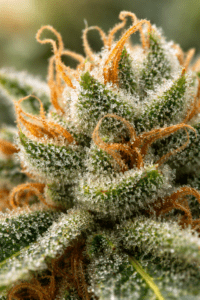
Trichomes are the microscopic, crystal-like resin glands covering cannabis flowers and sugar leaves. Trichomes produce and store the cannabinoids, terpenes, and flavonoids that determine a strain’s potency, aroma, and effect profile. Visually, dense trichome coverage gives mature cannabis flower its frosted or glittery appearance. Kief, the powdery concentrate collected from ground flower, consists almost entirely of trichomes separated from plant material.
Anther
The anther is the oval-shaped sac at the tip of the stamen in male cannabis plants where pollen forms, is stored, and is eventually released. Left undisturbed, anthers release pollen into the air to fertilize female plants. Breeders collect pollen from anthers and apply it to target female plants to produce new strain crosses.
Cola
A cola is the primary flowering cluster that forms at the top of a female cannabis plant. The main cola sits at the very top of the central stem and typically produces the densest, most resin-rich flower on the plant. Smaller colas develop lower on the branches. Dispensary flower is often harvested from upper colas where trichome density is highest.
Calyx
The calyx is the first structure that forms when a cannabis plant enters the flowering stage and the site of the highest cannabinoid concentration on the plant. Calyxes are small, teardrop-shaped formations that cluster together to form the bud. Trichomes concentrate heavily on calyx surfaces, making them the primary source of potency in harvested flower.
Pistil and Stigma
Pistils are the reproductive structures of the female cannabis plant. Each pistil contains a stigma, the hair-like strand extending outward from the calyx that captures pollen. Stigmas begin white and gradually darken to orange, red, or brown as the plant matures. Buyers see stigmas on dispensary flower as the orange and rust-colored hairs visible on the surface of mature buds. Stigma color and coverage help growers gauge harvest readiness but do not directly indicate potency.
Fan Leaf and Sugar Leaf
Fan leaves are the large, broad leaves extending from the main stem and branches of the cannabis plant. Fan leaves capture light and drive photosynthesis but carry very few trichomes and are not used in consumption or extraction. Sugar leaves are the smaller leaves growing directly out of and around the buds. Sugar leaves carry visible trichome coverage, giving them a frosted or sugary appearance. Trim from sugar leaves goes into lower-grade concentrates and pre-rolls.
Cannabis Basics and Effects
Before reading a dispensary menu, buyers need to understand how cannabis varieties differ and what those differences mean in practice. These cannabis terms cover the foundational concepts behind strain selection, expected effects, and how consumption format shapes the experience.
Indica
Indica is one of the cannabis terms buyers encounter most often at the dispensary counter. Indica strains originate from the harsh, high-altitude climate of the Hindu Kush mountain region across Afghanistan, India, Pakistan, and Turkey. Indica plants grow short, dense, and wide with broad leaves and produce buds faster than sativa. Indica genetics typically carry higher CBD levels relative to THC and produce deep body relaxation. Most consumers choose indica strains for evening use.
Sativa
Sativa strains grow tall and thin in hot, dry climates across Africa, Central America, and Southeast Asia. Higher THC concentrations and lower CBD levels characterize most sativa genetics. Consumers report energizing, creative, and anxiety-reducing effects. Sativa strains are popular for daytime use.
Hybrid
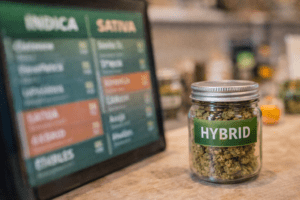
Hybrid is among the cannabis terms that causes the most confusion for new buyers, because it describes most strains on the menu. Hybrid strains cross indica and sativa genetics, producing effects that range from energizing to relaxing depending on the dominant lineage. Budtenders describe hybrids as indica-dominant, sativa-dominant, or balanced based on their expected effect profile. Cross-breeding has limited the availability of pure indica or pure sativa genetics.
Strains
A strain identifies a specific cannabis variety defined by its genetic lineage, cannabinoid profile, terpene composition, and expected effects. “Strains” sits at the center of the cannabis terms buyers use most when shopping. The industry uses “strain” interchangeably with “cultivar,” “variety,” and “selection.” Northern Lights, Blue Cheese, and OG Kush are recognized indica strains. Sour Diesel, Jack Herer, and Durban Poison are well-known sativa examples. Terrapin budtenders can walk through strain differences based on your desired effect, not just the indica/sativa label.
Flower
Flower is the harvested, dried bud of the female cannabis plant and the most common product format sold at Pennsylvania dispensaries. Among all cannabis terms on a dispensary menu, flower is the one most buyers already understand. Pennsylvania consumers may vaporize it. Budtenders describe flower by strain name, THC percentage, and terpene profile. Whole flower retains the full spectrum of naturally occurring cannabinoids, terpenes, and plant waxes; the most complete expression of a strain’s character.
Whole Flower
Whole flower is harvested and dried with no further processing before packaging. Compared to every other cannabis delivery format, whole flower contains the greatest number of naturally occurring cannabinoids and plant waxes. Only the bud is used. Nothing beyond inert plant matter is removed, preserving the full terpene and cannabinoid profile as the plant produced it.
Psychoactive
Psychoactive describes a cannabis product that produces an intoxicating effect. Products containing active Delta-9-THC are psychoactive. Pennsylvania adult-use dispensaries disclose THC content on all product labels.
Nonpsychoactive
Nonpsychoactive describes a cannabis product that produces no intoxicating effect. Products high in CBD and very low in THC fall into this category. Most topicals and many hemp-derived products are nonpsychoactive.
Dose
A dose is the measured amount of a cannabis product intended for a single session. For tinctures and capsules, dose refers to the milligrams of THC or CBD per serving. Pennsylvania dispensary labels list dose clearly. Newer consumers benefit from starting low and waiting to assess effects before consuming more, particularly with products where onset is delayed.
Dispensary
A dispensary is a licensed retail storefront selling tested medical or adult-use cannabis products, and the physical place where cannabis terms move from label to purchase decision. In Pennsylvania, dispensaries like Terrapin Care Station operate under strict state regulatory oversight. Every product on the shelf is tested, labeled, and compliant before it reaches a consumer. Dispensaries employ trained budtenders who translate product specifications into personalized recommendations based on desired effects, tolerance, and preferred consumption method.
Cannabis Terms and Dispensary Abbreviations
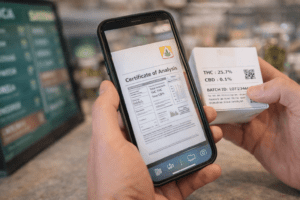
Cannabis menus and product labels run on abbreviations. THC, CBD, COA, BHO; buyers encounter these cannabis terms on every package and menu board. These definitions cover the most common cannabis acronyms and dispensary abbreviations used in Pennsylvania, with plain-language explanations of what each means and why it matters at the point of purchase.
THC — Tetrahydrocannabinol
THC is among the most searched cannabis terms in Pennsylvania and globally. It is the standard abbreviation for tetrahydrocannabinol, the primary intoxicating compound in cannabis and the driver of the euphoric high. On Pennsylvania dispensary menus, the THC percentage reflects a product’s potency per unit consumed. Four forms of THC appear in the cannabis plant: THCA, THCV, Delta-8-THC, and Delta-9-THC. When a menu lists “THC %” without further specification, it refers to Delta-9-THC.
CBD — Cannabidiol
CBD stands for cannabidiol and ranks among the most recognized cannabis terms for non-intoxicating use. It is the non-intoxicating cannabinoid used for inflammation, sleep disruption, pain management, and gastrointestinal support. Products labeled high-CBD contain more CBD than THC and produce calming effects without a pronounced high. The CBD-to-THC ratio on a label guides consumers toward the right balance of therapeutic and recreational effect.
THCA — Tetrahydrocannabinolic Acid
THCA is the raw, non-psychoactive precursor to THC present in unheated cannabis flower. Heat from smoking or vaporizing converts THCA into active Delta-9-THC through decarboxylation. Raw flower with a high THCA percentage delivers a potent high once consumed. Consuming raw, unheated cannabis produces no intoxicating effect because THCA has not yet converted.
THCV — Tetrahydrocannabivarin
THCV is a minor cannabinoid derived from THCA breakdown with properties distinct from standard THC. In low doses, THCV produces no intoxicating effect. In high doses or high-THCV strains, consumers report a clear, stimulating high with faster onset and shorter duration than Delta-9-THC. THCV suppresses appetite rather than increasing it, separating it from the classic cannabis hunger response.
Delta-8-THC
Delta-8-THC forms as Delta-9-THC ages and oxidizes. Compared to Delta-9-THC, Delta-8 delivers a milder, clearer-headed high with lower intoxication intensity. Stability when exposed to air distinguishes Delta-8 from its counterpart. Combining Delta-8-THC with CBD reduces intoxicating effects further.
Delta-9-THC
Delta-9-THC is what dispensary menus mean when they list “THC.” Found in both male and female cannabis plants, Delta-9 concentrates at far higher levels in female plants. In raw form as THCA, the compound carries no intoxicating effect. Decarboxylation triggered by heat converts THCA into Delta-9-THC and activates its ability to bind with CB1 receptors in the endocannabinoid system, producing a high.
BHO — Butane Hash Oil
BHO stands for butane hash oil, a category of cannabis extract produced using butane as the primary solvent during extraction. BHO appears under several names on dispensary shelves (wax, shatter, badder, budder, and oil) all describing the same extraction category in different final textures.
COA — Certificate of Analysis
A COA is a Certificate of Analysis and one of the most important cannabis terms for medical patients and safety-conscious buyers. It is the third-party lab report documenting the cannabinoid content, terpene profile, and contaminant testing results for a specific product. Pennsylvania state law requires all dispensary products to carry a COA before sale. Consumers can request a product’s COA at the point of purchase to confirm THC and CBD percentages and verify the product is free of pesticides, heavy metals, and microbial contamination.
THC-Free
“THC-free” on a product label means the product contains no quantifiable or detectable amount of THC. Trace amounts below laboratory detection thresholds may remain. THC-free products produce no intoxicating effect and suit consumers seeking cannabinoid benefits without any psychoactive response.
Full Spectrum
Full spectrum is among the cannabis terms buyers see most often on tincture and cartridge labels. Full-spectrum products retain the complete range of cannabinoids, terpenes, and plant compounds present in the original plant material, producing a broader effect profile than isolated compounds deliver individually. The entourage effect is strongest in full-spectrum products.
Broad Spectrum
Broad-spectrum cannabis products retain multiple cannabinoids and terpenes but remove detectable THC through additional processing. Broad-spectrum products suit consumers who want the multi-compound benefits of the entourage effect without any THC exposure. Broad-spectrum formats appear most commonly in CBD tinctures, topicals, and capsules.
Isolate
An isolate is a purified single cannabinoid extracted to the highest attainable concentration, typically 95% or above. CBD isolate and THC isolate are the most common formats. Isolates contain no other cannabinoids, terpenes, or plant compounds. Producers use isolates to formulate products with precise, predictable cannabinoid content. Consumers seeking a specific compound without the influence of other plant compounds choose isolate-based products.
Decarboxylation
Decarboxylation describes the chemical process that converts non-psychoactive THCA into active Delta-9-THC, and sits among the cannabis terms most misunderstood by new buyers. Heat from smoking, vaporizing, or baking triggers the conversion. Consumers making cannabis-infused preparations must decarboxylate flower before infusing it into a carrier, otherwise the finished product will contain THCA rather than active THC and produce no intoxicating effect.
Products and Consumption
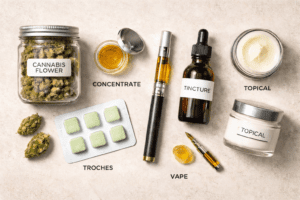
These cannabis terms cover the product formats and consumption methods a buyer encounters on a Pennsylvania dispensary menu. From concentrates and cartridges to tinctures and topicals, each entry explains what the product is, what it contains, and what to expect from it.
Concentrates
Concentrates represent a broad category of cannabis terms covering products that isolate and amplify the cannabinoids and terpenes from the plant, producing something significantly more potent than raw flower. Concentrates come in dozens of textures and formats. Inactive concentrates require heat to activate their effects. Active concentrates, most commonly distillate, go directly into tinctures and topicals without additional heat. Pennsylvania dispensaries carry concentrates in formats ranging from cartridges and badder to rosin and live resin.
Distillate
Distillate is a highly refined cannabis extract purified to isolate a single cannabinoid, most commonly THC or CBD, at very high concentration. Producers use distillate as the base ingredient for vape cartridges, tinctures, and topicals because it is odorless, flavorless, and potent. Distillate lacks the terpenes and minor cannabinoids present in full-spectrum extracts, producing a cleaner but less nuanced effect. Many cartridges sold at Pennsylvania dispensaries are distillate-based with terpenes added back after extraction.
Live Resin
Live resin is one of the most sought-after cannabis terms in the concentrates category. Produced from fresh, flash-frozen plant material rather than dried and cured flower, live resin preserves the terpene profile at peak freshness, producing a concentrate with notably higher terpene content and more complex aroma than concentrates made from cured flower. Live resin is one of the most flavorful concentrate formats available at Pennsylvania dispensaries.
Rosin and Live Rosin
Rosin and live rosin are solventless cannabis terms. Both are produced by applying heat and pressure to cannabis material with no solvents at any stage. Standard rosin uses dried flower, hash, or kief. Live rosin applies the same process to fresh-frozen material, preserving terpenes at the same level as live resin while maintaining solventless production. Both formats appeal to consumers who prefer purity and full terpene expression, and rank among the highest-priced concentrates on Pennsylvania dispensary menus.
Shatter
Shatter is a BHO concentrate with a brittle, glass-like consistency that breaks apart when handled. High temperatures during extraction and a stable molecular structure produce the translucent, amber appearance shatter is known for. Consumers dab shatter using a rig or load it into a compatible vaporizer. Shatter typically carries high THC potency.
Badder
Badder is a cannabis concentrate with a malleable, frosting-like texture. Starting material and extraction method determine the final appearance, so badder ranges from pale yellow to amber. Consumers dab badder or load it into a vaporizer. Badder’s workable texture makes it one of the more approachable concentrate formats for new concentrate consumers.
Budder
Budder is a soft, solid concentrate with a consistency similar to room-temperature butter. Budder appears in both rosin and solvent-based extractions. Consumers dab budder or load it into a compatible vaporizer. The whipping and agitation process during extraction gives budder its characteristic opaque, creamy appearance.
Kief
Kief is the powdery, trichome-rich residue that separates from cannabis flower during grinding or dry-sifting. Composed almost entirely of trichome heads, kief carries high cannabinoid and terpene concentration relative to the plant material it came from. Consumers add kief to packed bowls or use it to roll infused pre-rolls. Dispensaries sell kief as a standalone product and use it to infuse pre-rolls and other products.
Hash / Hashish
Hash is one of the oldest cannabis concentrates in the world, produced by collecting and compressing cannabis trichomes. Traditional methods include dry-sifting flower over screens and hand-rolling fresh buds to collect resin. Modern dispensary hash — including bubble hash and dry-sift hash — uses ice water or sieve screens to isolate trichomes before pressing them into a final product. Hash ranges from soft and pliable to firm and dense depending on production method and moisture content.
Extract
A cannabis extract is a concentrate produced exclusively through solvent-based extraction. Common solvents include butane, propane, ethanol, and supercritical CO2. All extracts are concentrates, but not all concentrates are extracts. Solvent-free products made through mechanical processes (dry-sift hash and rosin) fall outside the extract category.
Dab / Dabbing
A dab is a single-serving portion of cannabis concentrate consumed by vaporizing on a heated surface via a rig. Concentrates consumed as dabs carry significantly higher potency than flower. Vaporizing rather than combusting the material delivers a cleaner, more flavorful hit, particularly with high-terpene concentrates like live resin and sauce.
Cartridge / Cart
Cartridge and cart are cannabis terms buyers encounter at the dispensary counter and on nearly every vape display. A cartridge is a pre-filled, disposable or refillable chamber containing cannabis oil (most commonly distillate) attached to a vape pen battery. Carts are one of the most popular product formats at Pennsylvania dispensaries for their portability, discretion, and dose consistency. Labels list the oil type (distillate, live resin, full-spectrum), cannabinoid percentages, and terpene content.
Pre-Roll
A pre-roll is a factory-rolled cannabis cigarette sold ready to smoke. Pennsylvania dispensaries carry pre-rolls in single-strain, multi-strain, and infused formats. Infused pre-rolls add concentrate or kief to the flower, raising potency above standard flower levels. Pre-rolls offer a portable, consistent option for consumers who prefer not to roll their own.
Rig
A rig is a specialized pipe built for consuming cannabis concentrates. Heating the nail or banger to a specific temperature, then placing concentrate on the heated surface, vaporizes the material and produces a hit. A rig delivers concentrated cannabinoids and terpenes without combustion, producing purer inhalation than smoking flower at the correct temperature.
Tincture
A tincture is an oil-based cannabis product infused with THC, CBD, or a combination of both. Most tinctures use MCT (coconut) oil as a carrier, making them light and nearly flavorless. Consumers take tinctures orally or mix them into food and drink. Holding the tincture under the tongue before swallowing accelerates onset by allowing cannabinoids to absorb directly into the bloodstream through sublingual tissue.
Topical
A cannabis topical is a cream, oil, or lotion infused with cannabinoids and applied directly to the skin. Most topicals contain cannabinoid concentrations too low to produce intoxication. Consumers use topicals for localized relief from inflammation, muscle soreness, joint pain, and skin conditions. Topicals do not enter the bloodstream in significant concentrations and produce no systemic high.
Transdermal
Transdermal cannabis products deliver cannabinoids through the skin and into the bloodstream via adhesive patches containing specific cannabinoid ratios. Unlike topicals, transdermal cannabinoids penetrate deeply enough to enter circulation and produce systemic effects. Transdermal delivery suits consumers who want precise, timed cannabinoid release without inhalation.
Vape / Vaporizer
Vape and vaporizer are cannabis terms that cover any device heating cannabis flower, oil, or concentrate to a temperature that releases active cannabinoids without combustion, producing vapor rather than smoke. Vaporizers range from handheld pens to portable units to desktop models. Eliminating combustion removes tar and carcinogens from inhalation, making vaporizers a preferred option for medical patients and consumers who want cleaner delivery. Devices appear under several names: vape pen, weed pen, e-nail, and dab rig all fall within the vaporizer category.
Shop at Terrapin Care Station
Terrapin Care Station operates medical dispensaries across Pennsylvania. Our budtenders know these cannabis terms by heart and translate any of them into a product recommendation matched to your needs, tolerance, and goals. Looking for concentrates? Terrapin carries Double Bear Concentrates, a house brand built for Pennsylvania consumers who demand quality and consistency. Find your nearest Terrapin location and browse the full menu.